Home

News Room

FEATURED

AI for Dermatology Unlocks New Opportunities for Health Systems

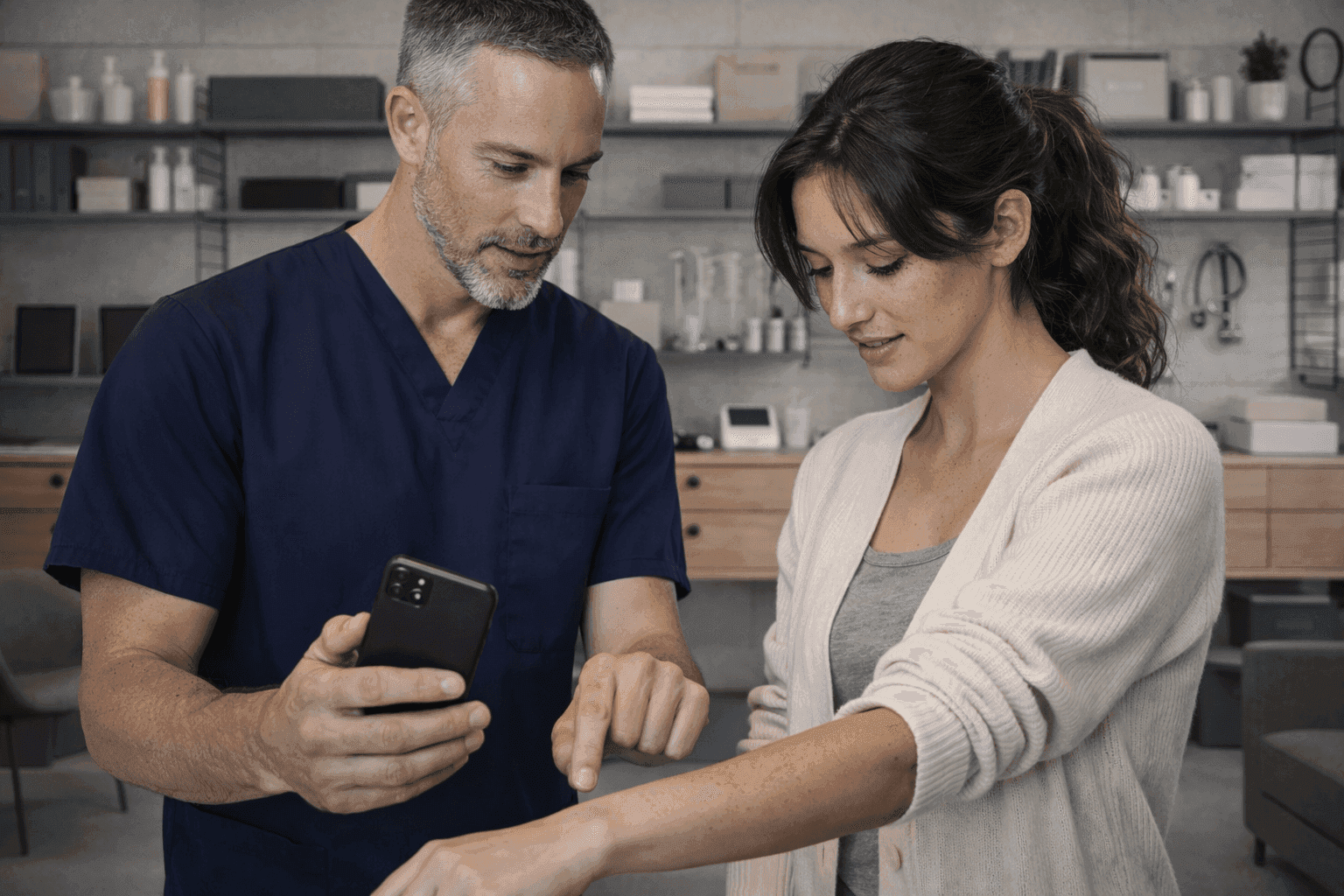
As demand for dermatology continues to surge, health systems are feeling the strain of limited specialist capacity and growing patient backlogs. Long wait times—often driven by low-acuity referrals—are not just an inconvenience, but a threat to access, outcomes, and revenue. Emerging models, like store-and-forward teledermatology paired with AI-enabled clinical decision support, offer a powerful way to rethink triage and care delivery. This article explores how combining smarter workflows with advanced technology can help health systems improve efficiency, reduce costs, and keep more patients within their networks.

Skin conditions affect 30-70% of individuals in all geographies and age groups.1 A two year study at the University of Miami showed that 36% of primary care patients report at least one skin condition.2 But the demand for dermatology care is not static; rather it is increasing as the population ages and there is an increase in the prevalence of skin cancer and chronic inflammatory skin disease.3,4

A key challenge for health systems is the perennial shortage of dermatologists, particularly in rural and underserved areas.5 This shortage is only getting worse as the rate of dermatologists entering the workforce fails to keep pace with increasing demand.6 Not coincidentally, wait times for dermatology are increasing year over year, with the current average at 36.5 days.7

Long wait times for dermatology result in patient leakage and significant costs from delayed treatment.8,9 For conditions such as skin cancer, inflammatory dermatoses, or infections, delays may worsen prognosis or increase long-term costs. From both a clinical and health system perspective, diagnostic inefficiency in dermatology carries a substantial burden. Reducing diagnostic error and wait times is not only a matter of patient safety, but also of healthcare efficiency and cost containment.

Primary care is generally on the front line of providing initial evaluation, diagnosis, and triage of skin conditions.4 However, non-specialists receive limited dermatology training. As a consequence, there is low concordance between non-specialists and specialists for diagnosis and treatment.2,10 Primary care is also overburdened so may rapidly refer to save time. Studies show that up to 60% of referrals to dermatology could be handled at primary care.2,11,12 The unfortunate side effect is that low acuity cases clog dermatologist schedules and take focus away from higher acuity cases. This dynamic not only increases cost for less complex conditions but also reduces potential revenue if dermatologists were able to focus on more complex conditions.

Many health organizations use store-and-forward teledermatology to help address these issues. In this model, primary care sends eConsults to dermatologists. Dermatologists review the cases asynchronously then provide guidance on diagnosis and treatment. Studies show that store-and-forward achieves clinical outcomes comparable to traditional in-person dermatology consultations.13 Further, both patients and providers report high satisfaction.14 

However, there are challenges for store-and-forward such as lack of technology support. Moreover, eConsults still depend on the limited specialist workforce; the same shortages affecting traditional care. This is where AI can help make a difference to further supplement and empower primary care.

Studies show that AI-enabled clinical decision support significantly improves diagnostic accuracy for primary care treating skin conditions.15,16 However, to realize an operational impact, this technology must be effectively integrated into clinical workflows. Store-and-forward presents an excellent opportunity to do just that. This is exactly the approach taken by Dermatic Health. Our platform supports both in-clinic and store-and-forward workflows, integrates with the EHR, and incorporates AI-enabled CDS between evaluation and eConsult. This model optimizes triage and reduces low acuity referrals. Our integrations and automations also improve workflow efficiency for completing an encounter, sending patient education, placing orders, and more.

Increasing demand for dermatology care presents both challenges and opportunities for health systems. A persistent shortage of dermatologists causes long wait times that are only exacerbated by low acuity referrals. Store-and-forward teledermatology is a proven workflow that can be supercharged with AI-enabled clinical decision support to optimize triage, reduce cost, and improve outcomes. By combining workflow innovation with advanced technology, health systems can improve efficiency and drive revenue, allowing them to focus more on increasing patient capture and less on preventing patient leakage.

1. Hay RJ, Johns NE, Williams HC, et al. The global burden of skin disease in 2010: an analysis of the prevalence and impact of skin conditions. J Invest Dermatol. 2014;134(6):1527-1534. doi:10.1038/jid.2013.446 

2. Lowell BA, Froelich CW, Federman DG, Kirsner RS. Dermatology in primary care: Prevalence and patient disposition. J Am Acad Dermatol. 2001;45(2):250-255. doi:10.1067/mjd.2001.114598 

3. Wang R, Chen Y, Shao X, et al. Burden of Skin Cancer in Older Adults From 1990 to 2021 and Modelled Projection to 2050. JAMA Dermatol. 2025;161(7):715-722. doi:10.1001/jamadermatol.2025.1276 

4. Lim HW, Collins SAB, Resneck JS, et al. The burden of skin disease in the United States. J Am Acad Dermatol. 2017;76(5):958-972.e2. doi:10.1016/j.jaad.2016.12.043 

5. Feng H, Berk-Krauss J, Feng PW, Stein JA. Comparison of Dermatologist Density Between Urban and Rural Counties in the United States. JAMA Dermatol. 2018;154(11):1265-1271. doi:10.1001/jamadermatol.2018.3022 

6. Is there a shortage of dermatologists? PracticeLink. Accessed January 13, 2026. https://practicelinkwp.wpenginepowered.com/resource-center/physician-next-practice/is-there-a-shortage-of-dermatologists/ 

7. Wait times for a dermatology appointment U.S. 2025. Statista. Accessed January 12, 2026. https://www.statista.com/statistics/1489221/dermatology-office-wait-times-in-days/ 

8. Patients Are Waiting: America’s Dermatology Wait... : Journal of Dermatology for Physician Assistants. Ovid. Accessed January 14, 2026. https://www.ovid.com/jnls/jdpa/fulltext/01356735-201913020-00008~patients-are-waiting-americas-dermatology-wait-times 

9. Barriers to Care-Seeking and Treatment Adherence Among Dermatology Patients: A Cross-Sectional National Survey Study. JDDonline - Journal of Drugs in Dermatology. Accessed January 14, 2026. https://jddonline.com/articles/barriers-to-care-seeking-and-treatment-adherence-among-dermatology-patients-a-cross-sectional-national-survey-study-S1545961622P0677X/ 

10. Bae GH, Hartman RI, Joyce C, Mostaghimi A. Comparing dermatology referral patterns and diagnostic accuracy between nonphysician providers, physician trainees, and attending physicians. J Am Acad Dermatol. 2016;75(1):226-227. doi:10.1016/j.jaad.2016.02.1213 

11. González-Cruz C, Descalzo MÁ, Arias-Santiago S, et al. Proportion of Potentially Avoidable Referrals From Primary Care to Dermatologists for Cystic Lesions or Benign Neoplasms in Spain: Analysis of Data From the DIADERM Study. Actas Dermosifiliogr. 2019;110(8):659-665. doi:10.1016/j.ad.2019.02.003 

12. Navein JF. Guidelines partly explain differences in referral rates. BMJ. 2002;325(7373):1177. doi:10.1136/bmj.325.7373.1177 

13. Barros-Tornay R, Ferrándiz L, Martín-Gutiérrez FJ, et al. Feasibility and cost of a telemedicine-based short-term plan for initial access in general dermatology in Andalusia, Spain. JAAD Int. 2021;4:52-57. doi:10.1016/j.jdin.2021.05.002 

14. Brinker TJ, Hekler A, von Kalle C, et al. Teledermatology: Comparison of Store-and-Forward Versus Live Interactive Video Conferencing. J Med Internet Res. 2018;20(10):e11871. doi:10.2196/11871 

15. Esteva A, Kuprel B, Novoa RA, et al. Dermatologist-level classification of skin cancer with deep neural networks. Nature. 2017;542(7639):115-118. doi:10.1038/nature21056 

16. Liu Y, Jain A, Eng C, et al. A deep learning system for differential diagnosis of skin diseases. Nat Med. 2020;26(6):900-908. doi:10.1038/s41591-020-0842-3 
Telemedicine

AI

Healthcare

John Langton, PhD

FEATURED

Hallucinations versus Errors and the Implications for Clinical Decision Making

The potential for artificial intelligence (AI) in healthcare is immense. Generative AI (GenAI) has stolen the headlines from other algorithms, but it is not the only game in town. Moreover, there is a difference in how errors occur depending on what is “under the hood”. A basic understanding of these differences is critical for making informed clinical decisions. Here we compare hallucinations with errors and provide rules of thumb that clinicians can use to better interpret AI output. 

The term AI is often used as shorthand for GenAI but encompasses much more. Large language models (LLM) are a type of GenAI, which is a type of deep learning, which is a type of neural network, which is a type of machine learning, which is a type of AI. The big difference in “modern AI” is the use of foundation models that generally involve a transformer neural network architecture and unsupervised pretraining on massive amounts of data. Foundation models can be used for both GenAI and non-GenAI use cases such as prediction and classification. The differences are in the output which has significant consequences for how we calculate error. 

Discriminative AI is a counterpart of generative AI. Dermatic Health uses both, each for different use cases. A common use case for discriminative AI is classification. For instance, predicting whether a patient has one of 73 possible dermatology conditions is classification. One could provide clinical notes to an LLM and ask what the condition is. However, the way discriminative and generative models take input, generate outputs, and evaluate results is fundamentally different. 

Generally speaking, discriminative AI works on structured inputs (e.g. lab results) whereas GenAI works on unstructured inputs (i.e. text). For discriminative AI, there is a set number of possible outputs that are definitively right or wrong. That makes it possible to calculate classic metrics such as type 1 errors, type 2 errors, positive predictive value (PPV), and even confidence intervals for predictions. For GenAI, we cannot calculate these metrics in the same way. A GenAI “hallucination” simply means the output doesn’t match human expectations, but it’s far more difficult to quantify right or wrong.

One can think of an LLM as an extremely high dimensional representation of the joint probability distribution across sequences of word fragments. LLMs predict the most likely sequence of words that should follow yours. There is work in neurosymbolic AI that uses formal logic, but LLMs generally do not. There is no explicit representation of right or wrong. Think about asking GenAI to help write an email. Is there a correct email and an incorrect email? GenAI operates in the same fashion when you ask it a clinical question. 

There are ways to mitigate these issues with LLMs such as constraining their output. For instance, some products only use content from prestigious journals and provide references to source materials for all generated summaries. In general, the old adage of “the right tool for the right job” applies to AI. 

At Dermatic Health, we use multiple AI models for different use cases. We use GenAI for generating draft SOAP notes. We use LLMs to parse elements of history of present illness information (HPI) then structure this data as input to other AI models. We use discriminative AI to predict dermatology conditions. Our discriminative AI is based on a foundation model and therefore still benefits from “modern AI” techniques. However, this approach enables us to directly measure error and compute statistics such as accuracy and PPV.  

It is unlikely you will ever see a confidence score on GenAI output. If you do, ask how it is calculated. GenAI can be great for “jogging memory”. However, if the output is net new information for you, it’s imperative to validate against sources. Part of the challenge is that LLM answers are always framed in a plausible manner. The whole point is to generate output based on the most probable structure of text. The details are what matter. 

Confidence scores on discriminative AI (such as classifying dermatology conditions) can be interpreted as statistics. For instance, if Dermatic shows an 85% confidence that a patient has eczema, then this confidence score has a precise statistical interpretation: in 85% of the patient cases the model saw during training with similar images and metadata, the correct diagnosis was eczema. Our models are trained (and pretrained) on hundreds of thousands of cases and we assess statistical power and bias. Therefore, you can be assured that this correlation is true. But note that 85% is not 100%. Dermatic provides the top N most likely conditions with links to reference images and expert content. Our goal is to provide the best information at the right point in the clinical workflow so that clinicians can rapidly make informed decisions.

AI is a powerful tool with immense potential for improving healthcare. Modern AI generally refers to new solutions that leverage foundation models. These models can be used for both GenAI and discriminative AI. The former has hallucinations whereas the latter has errors. Errors can be interpreted using standard statistics whereas hallucinations cannot. It’s imperative to keep this in mind when deciding what tools to use for what use cases, and how to interpret their output.

Future

Trust

AI

Healthcare

John Langton, PhD and David Murphy, PhD

Hidden Costs of Misdiagnosis of Dermatology Conditions

Peter Drucker is credited with positing “you cannot improve what you do not measure”. Misdiagnosis is difficult to measure in operational metrics but tied to significant costs. In the age of AI, clinician decision support can not only improve outcomes but also significantly reduce the hidden costs of misdiagnosis. 

Healthcare operations teams live and breathe KPIs. Metrics like Medical Loss Ratio (MLR) and Relative Value Units (RVUs) are foundational to how performance is measured and decisions are made. These metrics are well understood, widely benchmarked, and deeply embedded in operations. If it moves MLR or RVUs in the right direction then it’s considered a win.

Operational teams naturally optimize for RVUs and/or MLR because they are so visible and tied to revenue and margin. However, knowing what drives these metrics is somewhat of a dark art. Several factors affect the bottom line but aren’t directly measured in operations data. For example, long wait times for specialists such as dermatologists can cause loss of revenue from patient leakage and increased cost from delayed treatment. Misdiagnosis is measured in clinical studies but generally not tracked in operational metrics. However, misdiagnosis may be one of the most significant drivers of cost. 

Skin conditions affect 30-70% of individuals in all geographies and age groups.1 A two year study at the University of Miami showed that 36% of primary care patients report at least one skin condition.2 Primary care is generally on the front line of providing initial evaluation, diagnosis, and triage of skin conditions.3 However, non-specialists receive limited dermatology training. As a consequence, there is low concordance between non-specialists and specialists for diagnosis and treatment2,4. Moreover, studies have shown a low concordance between dermatologists, and a panel of dermatologists.5 

A recent systematic review found that misdiagnosis in dermatology is associated with significant costs in the billions of U.S. dollars and an unintuitively high percentage of health system costs.6 Misdiagnosis of melanoma contributes ~$673 million in excess costs in the U.S.7 Up to $515 million can be attributed to misdiagnosis of cellulitis.8 Dermatology is on the front line of diagnosing lyme disease from erythema migrans.9 61% of patients in one survey indicate misdiagnosis or delayed diagnosis of lyme disease which can result in several thousand dollars of additional healthcare costs per case.10  

Multiple studies have shown the ability of clinical decision support to reduce clinical errors and associated costs.11–13 The greatest potential for AI in the short term is integrating with existing workflows to solve real-world pain points. This is exactly the approach of Dermatic health. By providing the right information at the right time within the clinical workflow, we empower primary care to address low acuity skin issues, streamline workflows for specialists, and generally serve as a “double check” to help reduce misdiagnosis and associated costs. While costs from dermatology misdiagnosis may not be well measured or well understood, the impact is very real. Implementing Dermatic can help mitigate these costs in addition to driving revenue through improved workflows. 

1. Hay RJ, Johns NE, Williams HC, et al. The global burden of skin disease in 2010: an analysis of the prevalence and impact of skin conditions. J Invest Dermatol. 2014;134(6):1527-1534. doi:10.1038/jid.2013.446 

2. Lowell BA, Froelich CW, Federman DG, Kirsner RS. Dermatology in primary care: Prevalence and patient disposition. J Am Acad Dermatol. 2001;45(2):250-255. doi:10.1067/mjd.2001.114598 

3. Lim HW, Collins SAB, Resneck JS, et al. The burden of skin disease in the United States. J Am Acad Dermatol. 2017;76(5):958-972.e2. doi:10.1016/j.jaad.2016.12.043 

4. Bae GH, Hartman RI, Joyce C, Mostaghimi A. Comparing dermatology referral patterns and diagnostic accuracy between nonphysician providers, physician trainees, and attending physicians. J Am Acad Dermatol. 2016;75(1):226-227. doi:10.1016/j.jaad.2016.02.1213 

5. Liu Y, Jain A, Eng C, et al. A deep learning system for differential diagnosis of skin diseases. Nat Med. 2020;26(6):900-908. doi:10.1038/s41591-020-0842-3 

6. Lehmann L, Appelbaum S, Ostermann T, Weber B, Hofmann SC. Medical error analysis in dermatology according to the reports of the North Rhine Medical Association from 2004 to 2018. JDDG J Dtsch Dermatol Ges. 2022;20(12):1603-1611. doi:10.1111/ddg.14899 

7. Bhattacharya A, Young A, Wong A, Stalling S, Wei M, Hadley D. Precision Diagnosis Of Melanoma And Other Skin Lesions From Digital Images. AMIA Summits Transl Sci Proc. 2017;2017:220-226. 

8. Weng QY, Raff AB, Cohen JM, et al. Costs and Consequences Associated With Misdiagnosed Lower Extremity Cellulitis. JAMA Dermatol. 2017;153(2):141-146. doi:10.1001/jamadermatol.2016.3816 

9. https://fyra.io. Lyme Disease Update. Practical Dermatology. Accessed January 2, 2023. https://practicaldermatology.com/articles/2017-oct/lyme-disease-update 

10. admin. Lyme & Tick-Borne Disease Misdiagnosis | IGeneX Tick Talk. IGeneX | Tick Talk. January 26, 2018. Accessed January 2, 2023. https://igenex.com/tick-talk/the-high-cost-of-misdiagnosis-for-patients-with-lyme-disease-and-other-tick-borne-diseases/ 

11. Delvaux N, Piessens V, Burghgraeve TD, et al. Clinical decision support improves the appropriateness of laboratory test ordering in primary care without increasing diagnostic error: the ELMO cluster randomized trial. Implement Sci IS. 2020;15:100. doi:10.1186/s13012-020-01059-y 

12. Zuccotti G, Maloney FL, Feblowitz J, Samal L, Sato L, Wright A. Reducing Risk with Clinical Decision Support. Appl Clin Inform. 2014;5(3):746-756. doi:10.4338/ACI-2014-02-RA-0018 

13. Taylor RA, Sangal RB, Smith ME, et al. Leveraging artificial intelligence to reduce diagnostic errors in emergency medicine: Challenges, opportunities, and future directions. Acad Emerg Med. 2025;32(3):327-339. doi:10.1111/acem.15066 

Dermatology

Healthcare

Early Detection

John Langton, PhD